
Conscience Acquittals: A Constitutional Backstop
1 September 2026
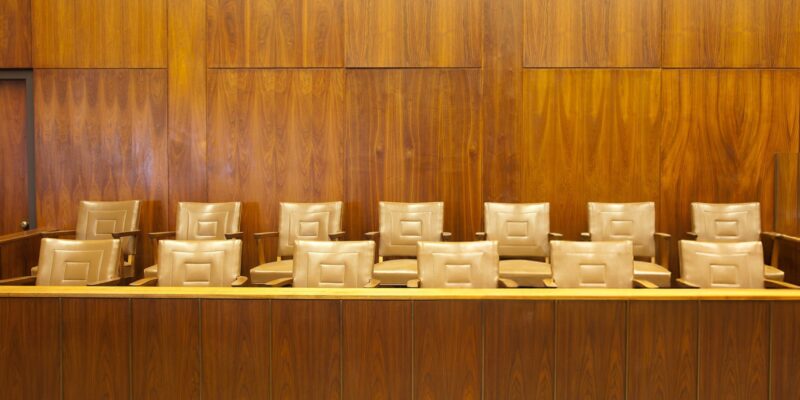
Garden Court North’s Pete Weatherby KC and Mira Hammad argue for jury equity and the power of jurors to act on their conscience. Credit: Jason Doiy / Shutterstock.
The notion of ‘jury equity’, ‘jury nullification’, and ‘perverse acquittals’ has become a hot topic of late. In this op-ed, Garden Court North’s Pete Weatherby KC and Mira Hammad argue that these are all terms for the power of jurors to act on their conscience, a constitutional backstop principle established over centuries, and recognised at the highest level of authority. The recent trend of forbidding counsel from addressing juries on the principle is without legal foundation, was not a feature of celebrated historical cases, and it is contrary to the imperative that jurors should receive full direction, and defendants should be able to have their cases fully ventilated.
In 1963, peace activists Michael Randle and Pat Pottle helped Soviet double agent George Blake escape from prison and later to flee to Russia. The escape was not only audacious and successful, but the men were not caught. Decades later they fully admitted their involvement in a book entitled ‘The Blake Escape, How We Freed George Blake and Why’, and subsequently they were arrested and charged. The trial judge directed the jury (correctly) that they had no legal defence but the jury acquitted nevertheless. This has been termed a “perverse acquittal” but in reality it was anything but. The defendants explained why they did what they did, they argued that to try them 26 years later was oppressive. The jury agreed.
In 1985 Clive Ponting, a senior civil servant at the Ministry of Defence (MoD), was charged with breaching the Official Secrets Act when he informed an MP that Ministers had misled Parliament over the sinking of the Argentine warship, the Belgrano, during the Falklands War. The jury were directed (correctly) that he had no legal defence, and once again the jury acquitted. Mr Ponting was a whistleblower. The jury can only have concluded that he did a public service which outweighed the fact that the evidence proved the elements of the offence in law, rendering conviction disproportionate and oppressive.
It is well recorded that in the 19th century juries often acquitted defendants in livestock theft cases: they did not want a defendant to hang for stealing a sheep.
In more recent times there have been countless political and protest cases where juries have done likewise, no doubt because they did not think the prosecution should have been brought in the first place or was otherwise oppressive. MS sufferers have been acquitted of cannabis offences, and manslaughter verdicts have been returned in mercy killing cases where murder was undoubtedly the strict legal answer.
It is therefore beyond argument that juries have acquitted “on their conscience” and the law allows them to do so, irrespective of legal directions. This is a wholly defensible part of the rule of law, not an affront to it. As Professor Spencer has argued, juries are ‘conscripts’[1], defendants have a right to be tried by members of their community. Jurors are not machines. They must be able to act on their conscience.
Since at least 1670 and the now well-known Bushell case[2], where a trial judge fined and imprisoned a jury for declining to return a guilty verdict, the principle of jury independence has been beyond question. Whatever verdict is returned, a jury cannot be impugned or prosecuted at common law.
In R v Wang [2005] 1 WLR 661, the House of Lords put beyond doubt the principle that a judge cannot in any circumstances direct a jury to convict.
If judges are prohibited from directing juries to convict, and jurors cannot be impugned at common law on any basis for their verdict, then as a matter of fact they have the power to determine a verdict on their conscience. But do they as a matter of law?
In Wang Lord Bingham set out the unanimous opinion of the Committee, having conducted a particularly comprehensive review of the authorities, no doubt because of the constitutional importance of the question but also because of conflicting previous Court of Appeal decisions, and the differing views of jurists. Amongst others, Lord Bingham referred to the 2001 ‘Review of the Criminal Courts‘, by Sir Robin Auld, who recommended statutory change to abolish ‘jury equity’. It is notable that no such provision has been forthcoming.
Having determined the question – that there are no circumstances in which a trial judge may direct a jury to convict – Lord Bingham emphasised that experience showed that juries were conscientious. In so doing he expressly cited Randle and Pottle, and Ponting as high profile acquittals “as much welcomed as resented by the public”. He went on to quote the well-known passage of Lord Devlin in ‘Trial by Jury’, 1956, p160-2), in which he asserted that in every case the “last word” must rest with the jury:
“an insurance that the criminal law will conform to the ordinary man’s idea of what is just and fair. If it does not, the jury will not be a party to its enforcement…”
Therefore, it is clear that Lord Bingham and the committee recognised that so-called perverse acquittals were permissible as a matter of common law, and did not occur only because there was no practical way of prohibiting them. The Court of Appeal in R v Webster [2026] EWCA 9 followed this position[3].
In the cases subsequent to Wang, HM Solicitor-General v Warner [2024] EWHC 918 KB, and R v Webster [(above cit), the High Court and Court of Appeal respectively have wrestled with practical issues arising from what jurors have been informed about “jury equity”, and an apparent tension added by amendments to the Juries Act 1974. Section 20C provides that a juror commits a criminal offence if they determine a case otherwise than on the evidence heard in the trial.
In Warner, Saini J rejected the Solicitor-General’s application for permission to bring contempt proceedings against a woman who held up a placard outside a court hearing a protest case. The legend on the placard read: “Jurors you have an absolute right to acquit according to your conscience”. The judge held that the placard stated the law correctly and there was no basis for contempt proceedings. However, he also stated that it was impermissible for advocates or anyone involved in the case itself to invite the jury to acquit on that basis or indeed to address the issue at all. This was based solely on the agreed position of counsel in the case to which we will return.
In Webster the Court of Appeal rejected an appeal grounded in part on the fact that the judge had given a direction that similar placards or posters outside the court misstated the law. The Court rejected the appeal, but doubted whether the judge’s direction was correct.
In so doing it noted the “tension” between “jury equity” and the juror’s oath and s20C.
Neither Warner nor Webster have altered the law on jury equity, nor could they. But two important issues arise from them. Firstly, whether there is indeed a tension with the statutory jury provision, or juror’s oath. Secondly, the proposition that a jury must not be informed or advised that they have a residual power to acquit even where the judge rules that the evidence does not provide a legal defence.
The juror’s oath is in these terms:
“I swear by Almighty God [or: I do solemnly, sincerely and truly declare and affirm] that I will faithfully try the defendant and give a true verdict according to the evidence”[4]
Section 20C was inserted into the Juries Act 1974 by s74(1), Criminal Justice and Courts Act 2015. As set out in Webster, it was introduced as a result of the problem identified in: AG v Davey, AG v Beard [2014]1 CrAppR 1. On his way home from court after having been sworn in, Mr Davey posted on FB:
“Woooow I wasn’t expecting to be in a jury deciding a paedophile’s fate. I’ve always wanted to Fuck Up a paedophile and now I’m within the law!”.
The relevant part of Section 20C is as follows:
- It is an offence for a member of a jury…
- …to try the issue otherwise than on the basis of the evidence.
Mr Davey was plainly indicating that he was going to convict on prejudice, not evidence. An acquittal on the basis of conscience does not rely on disputing legal directions or ignoring the evidence. It relates to a backstop where a jury finds that the prosecution was so improper or oppressive that it should not lead to conviction.
It is difficult to see how any juror in the Randle and Pottle or Clive Ponting cases could be said to have fallen foul of either the oath or s20C (had it been in force). There is no basis to suggest that they doubted the legal directions of the respective judges, or indeed based their acquittals on any evidence not before them. As Lord Bingham intimated, these acquittals were as much lauded as disapproved by the public, and were the product of Lord Devlin’s permissible “last word”. In summary, a jury may have no problem accepting the legal expertise of the judge, and consider no evidence but that before them on the trial, but still determine that in the particular case it would be oppressive, unfair or unjust to convict.
Whereas in the vast majority of cases, applying the evidence to the legal directions will take the jury to the particular answer, there are residual cases where that is not so. That is the law. Neither the oath or Section 20C requires otherwise. In reality there is no tension.
The second point arising from Warner and Webster is indeed perplexing. Whether an advocate or judge can or should address the issue of jury equity before a jury formed no part of the ratio of either case, nor does there appear to be any other clear authority on the point. In Warner, Saini J simply adopted the agreed position of counsel[5]. In Warner the Court noted that no reasoning had been provided for the rule but “we do not doubt it exists”[6].
In United States v Dougherty, 473 F.2d 1113 (D.C. Cir 1972) the Court conducted a wide review of the prerogative of juries to return verdicts on their conscience, reaching similar conclusions to the English authorities referred to above. However, the Court was split on the issue of whether the jury should be directed or addressed upon the matter. The majority held:
What makes for health as an occasional medicine would be disastrous as a daily diet. The fact that there is widespread existence of the jury’s prerogative, and approval of its existence as a “necessary counter to casehardened judges and arbitrary prosecutors,” does not establish as an imperative that the jury must be informed by the judge of that power. On the contrary, it is pragmatically useful to structure instructions in such wise that the jury must feel strongly about the values involved in the case, so strongly that it must itself identify the case as establishing a call of high conscience, and must independently initiate and undertake an act in contravention of the established instructions. This requirement of independent jury conception confines the happening of the lawless jury to the occasional instance that does not violate, and viewed as an exception may even enhance, the over-all normative effect of the rule of law.[7]
The majority lauded the power of juries to acquit on their conscience as an enhancement of the rule of law, but paradoxically opined that it was better not to tell them about it. Bazelon Chief Justice, delivered a powerful dissent:
The Court reasons that a jury uninformed of its power to nullify will invoke that power only where it “feel [s] strongly about the values involved in the case, so strongly that it [will] itself identify the case as establishing a call of high conscience…” Majority opinion at 1136. In other words, the spontaneous and unsolicited act of nullification is thought less likely, on the whole, to reflect bias and a perverse sense of values than the act of nullification carried out by a jury carefully instructed on its power and responsibility.
It seems substantially more plausible to me to assume that the very opposite is true. The juror motivated by prejudice seems to me more likely to make spontaneous use of the power to nullify, and more likely to disregard the judge’s exposition of the normally controlling legal standards. The conscientious juror, who could make a careful effort to consider the blameworthiness of the defendant’s action in light of prevailing community values, is the one most likely to obey the judge’s admonition that the jury enforce strict principles of law.
Moreover, if it were true that nullification which arises out of ignorance is in some sense more worthy than nullification which arises out of knowledge, the Court would have to go much further. For under the Court’s assumption, the harm does not arise because a jury is told of its power to disregard the law, but because it knows of its power. Logically construed, the Court’s opinion would seem to require the disqualification at voir dire of any prospective juror who admitted to knowledge of the doctrine. By excluding jurors with knowledge of the doctrine the Court could insure that its invocation would be spontaneous. And yet, far from requiring the exclusion of jurors who are aware of the power, the Court takes comfort in the fact that informal communication to the jury “generally convey[s] adequately enough the idea of prerogative, of freedom in an occasional case to depart from what the judge says.” Majority opinion at 1135. One cannot, it seems to me, have the argument both ways. If, as the Court appears to concede, awareness is preferable to ignorance, then I simply do not understand the justification for relying on a haphazard process of informal communication whose effectiveness is likely to depend, to a large extent, on whether or not any of the jurors are so well-educated and astute that they are able to receive the message. If the jury should know of its power to disregard the law, then the power should be explicitly described by instruction of the court or argument of counsel.
There are cogent arguments against the power of juries to acquit when the judge has withdrawn all available defences, but any change to that principle is for the legislature. It is undoubtedly correct that the judge is the arbiter of the law and the jury are the judges of the facts. Defendants and advocates may argue with the judge but once they have ruled the correct avenue to pursue the disagreement is by way of appeal, not via the jury. Similarly, the jury must accept the law to be as stated and directed by the judge. They must consider only the evidence before them. They must not act on sympathy or prejudice. However, as a matter of settled common law as asserted in all of the cases and in particular Wang, that is not an end to the matter. Nor should it be.
A juror is entitled to say, ‘I understand and do not deny the law as directed, and I consider only the evidence before me, however, on my conscience I am not prepared to convict’. Although the rule of law requires adherence to the common law and statutes determined by Parliament, and loyalty only to the evidence heard in the trial, that does not negate the centuries-old constitutional backstop that is an acquittal pursuant to conscience.
Neither does the juror’s oath, or amendments to the Juries Act brought about to combat rogue internet investigations by individuals, or decision by prejudice not evidence, as illustrated in Davey, negate that principle.
If Parliament had meant to abolish the constitutional safeguard of acquittal by conscience it would have clearly said so. Manifestly that was not its intention by the amendments to the Act, as explained in Webster.[8] The oath to deliver a true verdict according to the evidence, plainly does not preclude a jury accepting the legal directions, considering the evidence, and determining it would be wrong to convict in the particular case.
No system of justice is infallible. Despite hundreds of years of the rule of law in this jurisdiction we still have the prerogative of mercy, available to correct or ameliorate injustice. Such constitutional backstops enhance the rule of law, they do not offend it.
In 2005, Michael Shields was convicted of attempted murder in Bulgaria. He always maintained his innocence but his appeals were refused. He was repatriated to serve his sentence in the UK. It became clear that not only had he not been present at the scene of the crime but another had admitted to its commission. The Bulgarian authorities refused to reopen the case, yet he continued to serve his sentence in an English jail as required by the Convention under which he had been repatriated[9]. There is no judicial process available to right a miscarriage of justice suffered abroad. The High Court accepted that the Secretary of State had the power to pardon in such a case[10] and Mr Shields was released accordingly.
The backstop power of a jury to acquit where the facts are agreed and there is no legal defence is analogous to that: an exceptional prerogative where the law fails.
There is no authority for the proposition that a jury cannot be directed or addressed concerning this constitutional backstop power or principle, other than the US case referred to above. As noted, the assertion in Warner was made only on the basis of a concession by counsel, and the lack of an authoritative basis was noted in Webster. What other duty or power does a jury have upon which it is not directed and all discussion forbidden?
In our view the proposition that a jury cannot be so addressed is absurd. Similarly, there should be no prohibition on defendants adducing proportionate evidence of why they acted as they did. The abolitionists should lobby Parliament, not prevent jurors from understanding the law or the context of the case. The notion that ignorance of this constitutional principle or power will somehow contain it to its exceptional role is hopeless. It has become more so in recent times with the massive publicity around the Warner case and others.
We go further. Given that there is no statutory or common law basis for preventing juries being addressed about this principle (or the context), judges are wrong to make rulings forbidding it. What should happen is responsible discussion between judge and counsel, leading to the parameters of what can be said, and in those few cases where the principle or power arises, judges should give directions about it. Such directions would no doubt emphasise the respective roles of judge and jury, the oath and the Act, but it should also acknowledge that in the exceptional case the jury is entitled to act on its conscience.
Finally, it is clear that there was no judicial attempt to stop the defence in Randle and Pottle, or the Ponting cases from putting their case and urging the jury to acquit where the judge had directed that they had no legal defence[11]. The fact that a section of the judiciary is doing so in current climate change and Palestine direct action cases is a worrying and wrong turn. Judges should stick to the law, not politics.
[1] Archbold Review 31 July 2026, Issue 6, p8
[2] Bushell’s Case (1670) 124 ER1006
[3] Para 51
[4] CrimPR 25.6(9)
[5] Para 19
[6] Para 55
[7] P1137
[8] This is clear from a review of the parliamentary debate at the time of the introduction of s20C. See for example, the explanation as set out on behalf of the government at the committee stage by Lord Faulks; Criminal Justice and Courts Bill
Volume 755; Monday 28 July 2014, Column 1430; https://hansard.parliament.uk/Lords/2014-07-28/debates/1407281000320/CriminalJusticeAndCourtsBill#
[9] Convention on the Transfer of Sentenced Prisoners 1983 (CoE)
[10] Michael Shields v Secretary of State for Justice [2010] QB 150
[11] Although the Judge in R v Ponting made comment on the proposition in his summing-up
For further information, please contact Alex Blair, Communications Manager at Garden Court North Chambers: ablair@gcnchambers.co.uk